 Currently Buying Houses in Riverside County!
Home Selling Costs in Riverside County - Full 2026 Guide
Selling a home in Riverside County involves various costs that every seller should understand to prepare financially for the transaction. From realtor fees and closing costs to home repairs and taxes, the total expenses can add up quickly. This article will break down the typical home selling costs in Riverside County, helping you navigate the process more confidently and potentially save money along the way.
Cost of Selling a House in Riverside County
When selling a property in Riverside County, sellers can expect to pay several types of fees and costs associated with the sale timeline of their home. These costs typically include realtor commissions, closing costs, home staging and preparation expenses, home repairs, moving costs, and any remaining mortgage balance.
Additionally, sellers may be responsible for capital gains taxes depending on their personal situation and the profit made from the sale. Understanding these costs upfront can help sellers set a realistic asking price and avoid surprises at the closing table. Since most of these costs are a percentage of the sale price, it helps to know what homes are selling for in Riverside County right now.
Realtor Fees in Riverside County
One of the most significant costs when selling a house in Riverside County is realtor fees. These fees are usually calculated as a percentage of the home’s sale price and are split between the listing agent and the buyer’s agent.
The commission is typically specified as an agreed upon commission in the listing agreement signed by the seller and their agent, in accordance with recent regulatory changes. The average real estate commission in Riverside County typically ranges from 5% to 6% of the sale price, which is consistent with California closing costs standards.
This commission rate data is based on surveys of local agents and current market trends. Realtor commissions cover the services provided by both agents, including marketing the property, conducting a comparative market analysis, negotiating offers, and managing the closing process.
How to Save on Riverside County Agent Commissions
Sellers looking to save on agent fees can consider working with discount brokers or negotiating a lower commission rate with full-service realtors. Some agents may offer flexible commission structures, especially in a seller’s market where homes sell quickly and attract multiple offers.
Sellers can opt to handle certain tasks themselves, such as marketing or showing the home, to reduce the total realtor fees. However, it’s essential to weigh the potential savings against the benefits of professional services that can help maximize the home’s sale price.
Will the NAR Settlement Change Who Pays Realtor Commission?
Recent changes stemming from the National Association of Realtors (NAR) settlement may impact who pays realtor commissions in some real estate transactions.
Traditionally, sellers pay the total realtor commission, which is then split between the listing agent and buyer’s agent—including the buyer’s agent commission, which buyers expected the seller to pay prior to recent changes. However, evolving industry standards and regulations could shift some of these costs to buyers or alter how commissions are disclosed.
Sellers should stay informed about these changes, as they could affect the total cost of selling a home in Riverside County and the negotiation dynamics during the sale.
How to Completely Avoid Paying Realtor Commissions
For Riverside County homeowners who want to keep more of their equity, it’s entirely possible to avoid paying realtor commissions altogether — you just need to sell outside the traditional listing system.
1. Sell Directly to a Cash Home Buyer
Companies like Rivco Homebuyers buy houses fast directly from sellers, eliminating the need for real estate agents. Choosing a cash buyer instead of a Real Estate Agent can be a great way to sell. That means no 5–6% commission, no MLS listings, and no waiting for buyer financing. You get a fair, transparent cash offer and close on your timeline — often in as little as 7 days.
2. Handle a For Sale by Owner (FSBO) Transaction
Selling your house yourself can help you skip the listing agent’s fee. However, be prepared to handle pricing, negotiations, and paperwork on your own. In some cases, you may still need to pay a buyer’s agent commission (typically 2–3%) if their client brings the offer.
3. Offer Limited-Service Listings
If you want MLS exposure without paying full commission, consider flat-fee or limited-service brokerages. You pay a small upfront fee (usually a few hundred dollars) to list your property on the MLS, but you handle the rest of the sale process yourself.
Why Many Sellers Choose the Cash Route
For most homeowners in Riverside County, the biggest expense when selling is the realtor commission — often $25,000 – $40,000 on an average home. When you sell directly to a cash home buyer like Rivco Homebuyers, you immediately remove that cost from the equation. But the savings go far beyond commissions.
Unlike traditional listings, a cash sale is a straightforward, one-on-one transaction between you and the buyer. There are no middlemen, no open houses, and no financing delays. Understanding the cash buying process is simple, and once you accept the offer, the deal moves straight into escrow and closes in days, not months.
Breakdown of Closing Costs in Riverside County
Closing costs represent another significant portion of home selling costs in Riverside County. All closing costs are itemized in a settlement statement provided at closing, which details every fee and charge associated with the transaction.
These fees cover various services required to complete the real estate transaction and transfer ownership from the seller to the buyer. Typical closing costs for sellers include title insurance, recording fees, transfer taxes, title service fees, prorated property taxes, attorney fees, and home inspection.
The estimated cost of closing can vary depending on the home’s sale price and the specific services required. Closing costs can also differ based on the type of properties involved in the transaction.
Closing costs are a significant consideration for both the home seller and the buyer during a home purchase, and buyer’s closing costs are often negotiated as part of the deal.
When you sell a house in Riverside County, closing costs are the final expenses due at the end of the transaction. These costs usually total 1% to 3% of the sale price and cover various services needed to legally transfer ownership from seller to buyer. Below is a full breakdown of what you can expect to pay and what each fee covers.
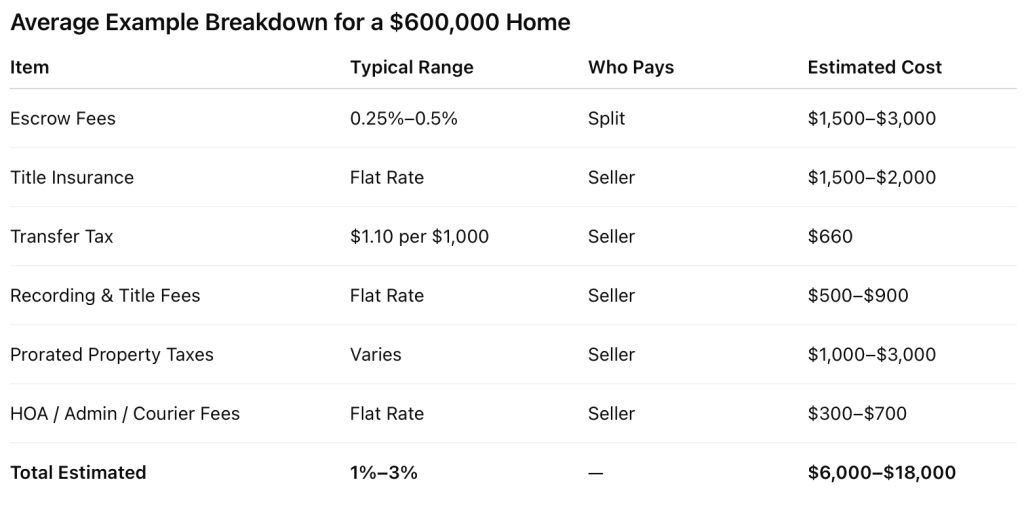
1. Escrow Fees
Escrow companies handle the exchange of funds and documents between buyer and seller.
- Typical range: $500 – $2,000
- Who pays: Usually split between buyer and seller
- Tip: Choose a local escrow company — fees can vary depending on the home’s sale price.
2. Title Insurance
Title insurance protects the buyer (and sometimes the lender) against ownership disputes, unpaid liens, or recording errors.
- Typical range: $1,000 – $2,500
- Who pays: Seller typically covers the owner’s policy; buyer covers the lender’s policy
- Tip: Shop around — different title companies charge different rates.
3. Title Service Fee
The title service fee covers administrative costs associated with processing the title documents and coordinating the closing. This fee is usually included in the closing cost statement and is paid by the seller.
- Typical range: $400 – $800
- Who pays: Seller
- Tip: Ask for a full estimate before signing — small admin fees add up quickly.
4. Recording Fees
Recording fees are charged by the county to officially record the deed and other documents related to the sale. These fees are typically modest but necessary to complete the real estate transaction legally.
- Typical range: $75 – $125
- Who pays: Seller
- Tip: Some escrow companies include this in their total fee, so check your estimate.
5. Documentary Transfer Tax
Transfer taxes, sometimes called transfer fees, are imposed by Riverside County or the state of California on the transfer of property ownership. The tax rate may vary depending on the sale price and local ordinances. Sellers should factor these taxes into their closing cost estimates.
- Rate: $1.10 per $1,000 of the home’s sale price
- Example: On a $500,000 home, the transfer tax would be $550.
- Who pays: Seller
6. Prorated Property Taxes
Property taxes in Riverside County are prorated between the buyer and seller based on the closing date. Sellers pay property taxes up to the day of closing, and buyers pay from that date forward. This proration ensures each party pays their fair share of annual taxes.
- Typical range: Varies by date of sale and assessed value
- Example: If you sell halfway through the year, you’ll pay roughly half of your annual tax bill at closing.
- Who pays: Buyer & Seller
7. HOA Transfer Fees (If Applicable)
If the home is part of a homeowner’s association, the HOA may charge a fee to transfer ownership and update records.
- Typical range: $200 – $500
- Who pays: Seller
8. Seller Concessions
Sometimes sellers offer credits to help buyers cover their own costs (e.g., inspections or repairs).
- Typical range: 0% – 3% of sale price
- Who pays: Seller (if agreed upon)
9. Courier and Administrative Fees
Small charges for document delivery, notary services, and handling physical paperwork.
- Typical range: $50 – $250
- Who pays: Seller (if agreed upon)
Small charges for document delivery, notary services, and handling physical paperwork.
10. Attorney Fees (Optional)
While not always required, some sellers hire a real estate attorney to review contracts, assist with negotiations, or handle complex transactions. Attorney fees vary depending on the services provided and can add to the overall closing costs.
- Typical range: $500 – $1,500
- Who pays: Seller (optional)
11. Mortgage Payoff and Prepayment Penalties
If you still owe money on your mortgage, that balance will be paid off from the sale proceeds at closing.
- Typical range: Varies by loan balance
- Tip: Check your loan terms — some mortgages have early payoff penalties.
12. Home Warranty (Optional)
Some sellers offer a home warranty as a buyer incentive, covering appliances or systems for a limited period.
- Typical range: $400 – $700
- Who pays: Seller (if offered)
13. Miscellaneous Government Fees
Includes notary public fees, county certifications, or environmental disclosures.
- Typical range: $50 – $150
How to Save on Riverside County Closing Costs?
Sellers can reduce closing costs by negotiating which fees they pay, shopping around for title insurance providers, or opting for a discount broker who may offer lower agent fees. Using a closing cost calculator can help estimate these expenses and identify areas for potential savings. Being proactive and informed during the closing process allows sellers to avoid unnecessary fees and save thousands of dollars.
Additionally, Rivco sellers can opt for a cash home buyer who pays the majority, if not all, of the standard closing costs.
Home Staging and Preparation Costs in Riverside County
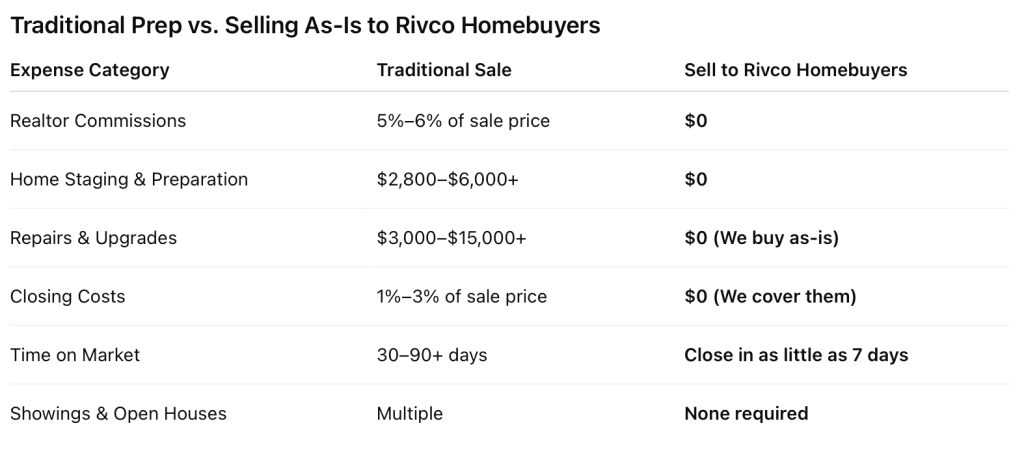
Preparing a home for sale in Riverside County often comes with significant out-of-pocket costs. Between deep cleaning, landscaping, minor repairs, and professional staging, sellers can expect to spend an average of $2,800 to $6,000 before their home even hits the market.
Full-service staging — which includes furniture rental, décor, and design setup — can add several thousand more, especially for vacant or larger homes. While staging can make a property more appealing to potential buyers, it doesn’t guarantee a faster or higher sale.
Many Riverside homeowners now choose to skip the staging process entirely by selling directly to Rivco Homebuyers, avoiding these upfront expenses and closing quickly without the stress of prepping their home for showings.
Average Home Repair Costs in Riverside County
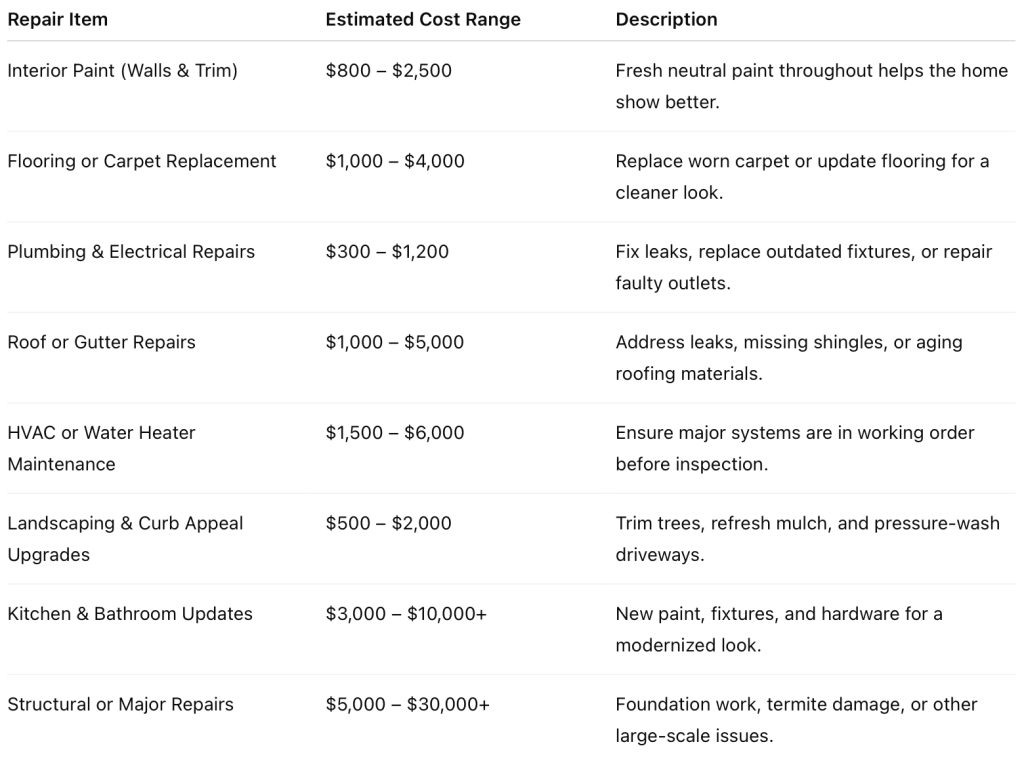
Before listing a home in Riverside County, most sellers face at least a few repair expenses to get their property market-ready. Costs can vary depending on the home’s size, age, and condition, but the table below outlines the most common repairs and their average price ranges.
How to Avoid Home Repair Costs Before Selling?
If you want to completely avoid the stress and expense of fixing up your home before selling, the easiest solution is simple — sell to a cash buyer.
When you list your home the traditional way, you’ll often spend thousands on repairs, cleaning, paint, and staging just to make it presentable for showings. Then you wait weeks or months for buyers to make offers, only to face inspection requests and last-minute repair negotiations.
Selling to a cash home buyer like Rivco Homebuyers eliminates all of that. We buy houses as-is, no matter the condition — leaky roof, outdated kitchen, or major repairs needed. You don’t have to fix a single thing. We handle everything after closing.
Instead of pouring money into a property you’re ready to move on from, you get a fair cash offer and close on your timeline — often in as little as 7 days. No repairs, no showings, no surprises.
Average Moving Expenses in Riverside County
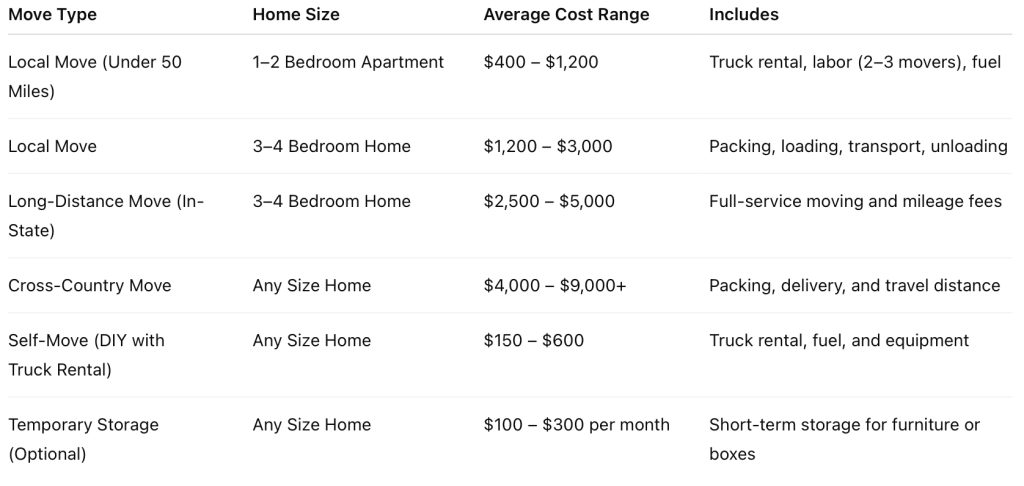
Moving expenses can be one of the most overlooked costs when selling a home in Riverside County. On average, homeowners spend anywhere from $1,000 to $6,000 depending on the distance, size of the home, and whether they hire full-service movers or handle it themselves.
Local moves within Riverside County usually fall on the lower end of that range, while long-distance relocations — especially out of state — can cost significantly more once packing, transportation, and storage fees are added.
It’s important for sellers to factor in these costs when calculating total selling expenses, as moving often becomes one of the final but most expensive steps in the process.
Remaining Mortgage Balance: Varies
Sellers must pay off any remaining mortgage balance at closing, known as the mortgage payoff. The exact amount depends on the loan payoff figure provided by the lender, which includes the principal balance and any applicable fees or penalties. Paying off the mortgage is a critical step to clear ownership and transfer the property to the buyer.
Capital Gains Tax
Sellers may be subject to capital gains tax on the profit from selling their Riverside County home, and most home sellers in California should be aware of these potential tax implications. This tax has both federal and state components.
Federal Capital Gains
At the federal level, capital gains tax rates depend on the seller’s income and the length of homeownership. Primary residences may qualify for exclusions up to $250,000 for single filers or $500,000 for married couples, reducing the taxable gain.
State Capital Gains
California also imposes state capital gains tax, which is calculated as part of the state income tax. Sellers should consult a tax professional to understand their specific tax obligations and plan accordingly.
We buy Riverside County Homes in all cities

Selling Your Riverside County House Fast
Get My Free,
No-Obligation Quote
Call us today at 951-783-4303 to get a free no-obligation cash offer in 24 hours or less.
Riverside County’s #1 Home Buyers!
Home Selling Costs in Riverside County FAQ
How Much Are Closing Costs in Riverside County?
Closing costs for sellers in Riverside County typically range from 1% to 3% of the home’s sale price, covering fees such as title insurance, transfer taxes, recording fees, and prorated property taxes.
Who Pays Closing Costs in Riverside County?
Most closing costs are paid by the seller, including realtor fees, title insurance, and transfer taxes. However, some costs may be negotiated, and in certain cases, sellers may agree to pay part of the buyer’s closing costs as concessions.
What Taxes Do You Pay When Selling a Riverside County House?
Sellers pay prorated property taxes up to the closing date and may be responsible for transfer taxes. Additionally, capital gains taxes may apply depending on the profit from the sale and the seller’s tax situation.